Influencer marketing is no longer an experimental line item — for many brands it’s one of the largest digital spend categories they have. But as the spend grows, so does an uncomfortable question: who actually knows where that money goes? One of the industry’s most comprehensive studies gives a clear, unsettling answer — most brands don’t.
What the numbers say
The U.S. Association of National Advertisers (ANA) surveyed 84 client-side advertisers who lead influencer marketing at their organizations and published the results in February 2026. The picture is stark:
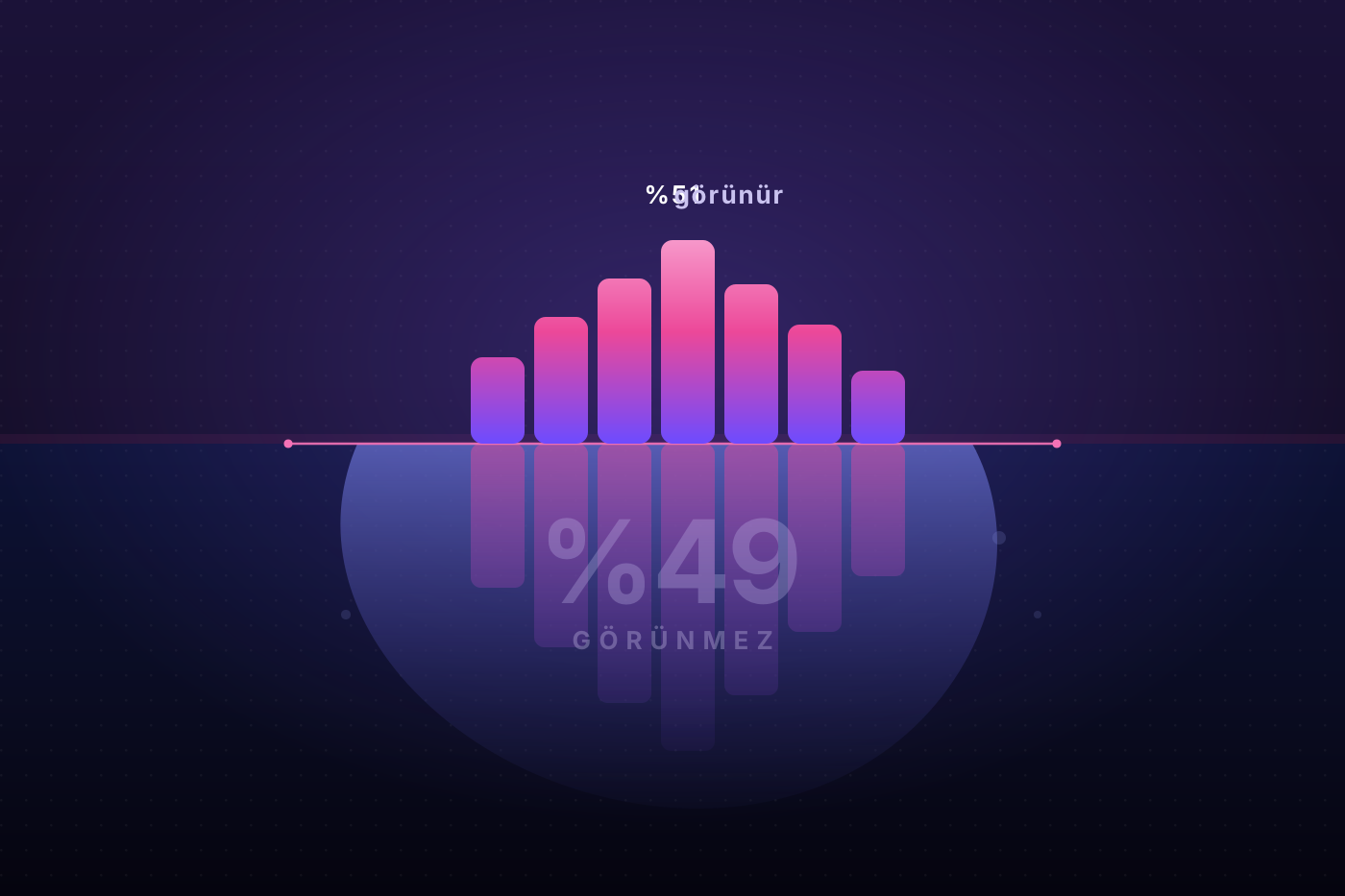
- Only 51% of advertisers have full visibility into the exact amounts paid to influencers.
- Just 39% of agreements are fully transparent to the brand; the remaining 61% are either explicitly non-transparent or unknown.
- Agencies take an average of 30% of influencer marketing spend as commission — leaving roughly 70% for the influencer.
- More than half of advertisers intend to change their compensation model within the coming year.
This is happening in a market expected to reach $43.9 billion globally in 2026 (about 18% annual growth). The industry is scaling fast — and a meaningful share of that spend is moving through a box brands can’t see into clearly.
Why the money “disappears”
The most common cause of lost transparency isn’t bad faith — it’s bundling. Many agencies roll content production, the influencer’s fee, commission, and production costs into a single lump figure. The brand sees an invoice but can’t separate how much went to the creator versus the intermediary. Payment structure makes it harder still: some campaigns are billed by project, some on a monthly retainer, a smaller share on performance — and when these models overlap, tracing the budget gets genuinely difficult.
What it looks like in Turkey
Turkey, with its high social media usage, is one of the most active influencer marketing markets, and it’s growing double digits year over year. The intermediary structure carries the same transparency tension: a traditional influencer agency typically charges either a project-based fee (often starting in the tens of thousands of lira) or a 20–30% commission on the campaign budget, while marketplace models take a lower per-transaction cut (typically 5–15%). Whatever the model, the result is the same: an unclear breakdown makes it hard for a brand to answer “did I get what I paid for?”
The real transparency problem: even when you can see the money, you can’t see the return
Everything so far is about where the money goes. But there’s a subtler gap: even if you break the invoice down to the last unit, you usually can’t see what you got in return.
That’s because the industry still measures success with volume metrics. In the ANA study, the metrics brands lean on most are 90% engagement rate, 87% impressions, 86% reach. The shared flaw of these three numbers is that they all measure how many people were reached but not what those people felt. A post can be seen millions of times and pull high “engagement” — but if that engagement is sarcastic comments, an audience with no relation to the product, or a shower of generic emoji, your budget went to a ghost result.
Seeing the invoice is one kind of transparency; the real question is whether that invoice bought a genuine reaction.
So budget transparency has two layers: (1) where did the money go, and (2) what did we get for it. The first layer is solved by contracts and clearer reporting. The second only becomes visible when you measure the quality of engagement.
How to close the gap
To close the second layer, the signals to look at aren’t volume — they’re meaning:
- The real tone of the comments — Is praise, indifference, or disappointment dominant? Reading the emotion inside comments tells you what a like count never will.
- Purchase intent — Questions like “What’s the price?”, “Where did you get it?”, “Is there a link?” are the most honest sign of genuine commercial interest.
- Audience authenticity — How much of the engagement comes from real accounts? An inflated audience distorts every metric — and your budget.
- Fee-to-value balance — Read the influencer fee you paid alongside the real engagement you received, and for the first time you can tell whether the quote was expensive or cheap.
Extracting these signals one by one across thousands of comments by hand isn’t practical. Measuring a campaign’s real impact means doing exactly that reading, systematically.
Summary
The ANA study’s finding, in one sentence: brands spend more and more on influencer marketing, yet half can’t clearly see where the money goes. The short-term fix is more transparent contracts and clearer reporting. But the real win comes when you solve the second layer of the problem — seeing whether the money bought a genuine reaction. That’s exactly what Vibemetri does: it reads a campaign’s comments one by one with AI, classifies them by tone, intent, and authenticity, and reduces scattered data into a single decision table. Your budget stops being a guess and becomes a measurable investment. Take a look at Vibemetri.
The statistics in this article are compiled from the U.S. Association of National Advertisers’ (ANA) influencer marketing study published in February 2026 and from public industry sources. The Turkey commission ranges are approximate and vary with campaign scope, timing, and negotiation.